Origins of other japanese Bondages
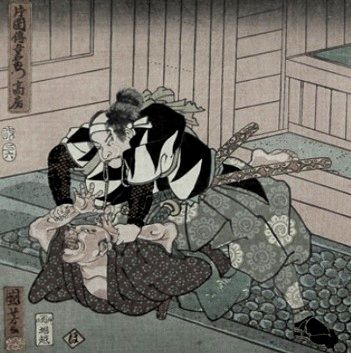
Hojôjutsu
Important notice. Although Kinbaku techniques originate
from Hojôjutsu, the techniques in modern sexual bondage are far
gentler and great care is taken to avoid injury.
Please avoid using rope tight around the neck and especially when doing
suspension work.
Background of modern Kinbaku
Hojôjutsu or Torinawajutsu (skill of arresting with rope)
can be traced back to the battle of Onin (1467) and evolved as a practice
during the Warring States period (Sengoku Jidai) as Nawajutsu (rope
skill). The objective at that time was to keep a prisoner alive so that
they might later be willing to provide valuable information or, if they
were thought to be valuable, as a hostage for exchange rather than bring
him to court as a criminal. In neither of these instances was the long
term health of the prisoner of particular concern, so a prisoner could
talk a lot before someone took his life and, in the event of an exchange,
you were going to cut that hand off to send with the ransom note anyway.
The prisoner often suffered permanent damage or death in the process.
Its restrictive use was extremely painful and would often
result in long-term nerve and circulation damage or death. Its punishment
was psychological too, bending people into positions of humility with
tightening rope around the neck if the victim struggled and hanging
prisoners suspended in positions of complete helplessness. Hobakujutsu
(skill of seizing/capturing/restraining) is another term used similar
to Hojôjutsu and used in old as well as modern Kobudo (older Japanese
martial arts) practice alongside Nawanuke no jutsu (skill of escaping
rope). I have recently been told that some Japanese Kinbaku-Shi still
use the term Hobakujutsu for suspension work.
Hojojutsu was used by the Bushi and Ninja as well as the
Keisatsu-kan (police) for many centuries and included in Bugei Juhappan
(18 warrior skills). It was seen as a complement to the other skills
practiced like Jutte, Bo, Kusarigama or Kusarifundo, after students
had learned unarmed combat like dakentai-, jutai-, koppo- or koshijutsu.
During the Tokugawa and Edo periods, the administration
of law enforcement was conducted by the Machi Bugyo, who hired Yoriki
with 2 swords as officers and Doshin with 1 sword as patrolman. They
had control over various kinds of assistants that were not Bushi like
Torimono, Goyoukiki and Okappiki. Yoriki and Doshin regarded the work
of restraining someone beneath them and left it to their servants or
constables whose job it was. In the city of Edo (modern day Tokyo),
there were about 25 Yoriki working each for the two Machi Bugyo offices.
Since police officers worked in groups of at least four, they could
have one person secure the prisoner while preventing the prisoners escape
and coincidentally shielding the performance of the technique from view.
The art of tying prisoners was in demand all over Japan and perfected
by many ryu in Japan at that point in time. There were four rules for
tying a person:
Not to allow the prisoner to slip the bonds
Not to cause any physical or mental injury
Not to allow others to see the techniques
To make the result beautiful to look at
During this period tying a person was considered as a grave matter,
not to be undertaken lightly. People felt that the shame of having a
rope around their necks and knots on their person was disgraceful and
considered for some to be worse than death itself. If the proper procedure
for restraining a suspect was not followed, the person who applied the
restraint could be impeached. If, however, the restraints contained
no knots, they were not considered a bondage and thus were not disgraceful
to conduct. The use of Jakuguchi ?? (loop at end of rope) is therefore
frequently used in a kind of knitting way.
In 1742, Tokugawa Yoshimune was the Shogun in Japan and enacted Kujikata
Osadamegaki (lit. "book of rules for public officials’) with
7 different types of punishment (Penal labor, imprisonment, slavery,
exile, death, confiscation) and 4 kinds of torture:
Mutchiuchi (whipping) beating/flogging/whipping
Ishidaki (pressing stone) Kneeling on a corrugated surface
and thereafter heavy pressing stones are placed upon the thighs
Ebizeme (constriction by rope) cross-legged sitting position
and their chest and head are folded over and bound to the legs.
Tsurizeme (Suspension by rope) Suruga Doi (incident of Suruga torture)
refers to a provincial type of tsurizeme and was invented by the local
Machi Bugyo sometime during the Tokugawa period. This suspension form
consists of tying the victims four limbs together behind his back in
a bundle, suspending him from the ceiling by this single rope, and placing
progressively heavier weights in the middle of his back or as weight
hanging from below the stomach. Similar to Sakasa Tsurushi Shibari nawa
and other provincial names and incidents.
Later during Meiji restoration many ryu ceased to exist;
as a result, the Bushi was disbanded and formal standards were imposed
by the new rule, e.g. the rope length was then set to 7 and 15 meters.
As there was less use for the art, the number of practitioners fell.
Types of Rope
Though several types of ropes and cords are used in Hojojutsu,
all are considered Torinawa (arresting rope). Silk ropes were primarily
used for practice because it was easy to slip from bonds made of these
ropes. Hemp, beaten until soft, and often linen, were most used for
the actual performance of these techniques. The rope was typically 3-4
mm in thickness.
Hayanawa (Quick rope) was set to 22 shaku (app. 22 feet)
or 2½ hiro (fathom) = 4.5-6.5 meters long and sometimes a hook,
ring of metal or other metal piece is tied to one an end. It was very
common that the rope was hidden in a sleeve so as not to alert the suspect
and for the element of surprise. There was a general rule in capturing
prisoners with rope that it should not exceed 10 seconds to perform.
Honnawa (basic rope/main rope) was set 66 shaku or 54
shaku or 5, 7, 9, 11, or 13 hiro = 6.5-22 meters. This was a required
equipment for Bushi and used for escorting prisoners.
Kaginawa (Hookrope), the practices of rope with hooks, were used by
the Kumogakure ryu Ninjas among others. In the three well known Ninja
manuals (Shoninki, Bansenshukai, Ninpiden), you can find instructions
on how to use the Kaginawa to climb trees and walls and to tie an enemy.
There is no fixed length for a Kaginawa – the hook can be attached
to any rope or chain. Very similar weapons were used by Ninja (and some
Samurai) called Kyoketsu Shoge and another called Kusarigama.
Koshinawa (waistrope) about 5 shaku (feet) long, especially
those of the Chinese type, (Kara Uchi No Himo) are fastened to a samurai's
belt and used for securing prisoners. In addition, these ropes could
be used for other purposes, Kura Gatame (securing a saddle), Shiba Tsunagi
(tethering a horse), climbing a wall, securing a boat, or hanging up
armor. Some claim that the Koshinawa later evolved to a chained version
called Kusarifundo (used extensively by Edo Machi Bugyo and some Ninja
Ryu).
Sageo (The rope that is attached to the sheath of a Japanese
sword) was used to fasten prisoners. Tagaki Yoshin ryu has this practice,
among others, due to it being a bodyguard school; therefore, it has
lots of floor-work included. Similar to Kaginawa, you will find information
in well-known Ninja-manuals such as Sageonanajutsu Seven techniques
of Sageo.
Torihimo (Arresting cord) 2 hiro long cord used during
Edo period to arrest. The cord was folded in two equal long parts and
many different techniques were used. Often used with other weapons like
Jutte, Tessen or similar old time Japanese police weapons.
Colour of rope
In old days there were traditions concerning the use of colours of rope,
these traditions matured during the Tokugawa Era and has origins from
China and Korea (Confucianism and Taoism). You might recognize the ideas
in the building architecture across Eastern Asia. The most known traditions
are:
Blue rope: spring - east - left - Dragon
Red rope: summer - south - forward - Phoenix
White rope: fall - west - right - Tiger
Black rope: winter - north - backward- Tortoise
Prisoners were forced to sit facing the direction matching
the colour only to please the eye of the audience. In prison, the ropes
were blue for a period of time in history and during the dog days (July/August)
yellow ropes were used. Later, during the Meiji period, the colour of
the ropes changed according to status:
White ropes: lesser crime
Blue ropes: serious crime
Purple ropes: a person of high rank
Black ropes: a person of low rank
Traditions
More than 120 Japanese traditions (Ryu) have documented techniques
for tying up prisoners and I do not have knowledge of them all. If you
really wish to research, I recommend looking for Japanese books on the
topic. I have discovered the following from the sources mentioned in
the footnote on this page. These are the ryu (and more) that involved
hojojutsu: Bo Ryu, Chokuji Goden Ryu, Eishin Ryu, Fujiwara Ryu, Ichi
ryu, Ittatsu Ryu, Jittetori Ryu, Kiro ryu, Kito Ryu, Kurama Yoshin Ryu,
Kurokawa Ryu , Kushin Ryu, Mitsuo Muteki Ryu, Nanbu Handen Hojo Jutsu,
Ogawa Ryu, Seigo Ryu, Serishin Ryu, Sekieuchi Ryu, Shibukawa Ryu, Shin
Shin Ryu, Shinden Fudo Ryu, Shinden Muso Ryu, Shintô Musô
Ryu, Tagaki Yoshin Ryu, Takimoto Ryu, Takenouchi Ryu, Tenfu Muso Ryu,
Tenjin Shinyo Ryu, Yoshin Ryu and Edo Machikata hojô (Edo administration
of law enforcement rope arrest) are well known.
One very well known ryu is Ittatsu ryu which was founded by Suzaki Kinzaemon
in 1723, later passed on as Shintô Musô Ryu and still used
by Japanese police as Taihojutsu (arresting skill). The rope used in
Ittatsu ryu is about 5 meters in length and a diameter of about 3.5
mm. Ittatsu ryu techniques are named Nawa Waza and include:
Ge no kata Ge no kata Jô no kata
Ichimonji hayanawa Hishi hayanawa Jumonji hayanawa
Hagai tsuke hayanawa Hishi nawa Jumonji nawa
Hitoe hishi nawa Jumonji nawa Futae hishi nawa
Shin hagai tsuke nawa
Bajo hagai tsuke nawa Kiko nawa
Ya hazu nawa
Tombo nawa Age maki nawa
Sumi chigai nawa Shin futae hishi nawa
Shin hagai tsuke nawa
Shin tombo nawa Shin kiko nawa
Munawari hitoe hishi nawa
Happo karami nawa Yagura hishi nawa Kiri nawa
Yagura hishi nawa
Some ryu have relations to others like Hinoshita torite
Kaizan Takenouchi-ryu, Shinden Fudo ryu dakentaijutsu and Tagaki Yoshin
ryu jutaijutsu, which is common in Japanese martial arts ryu and it
seems obvious that they learned from each other in regards to techniques
and mindset.
Some techniques were kept secret to ensure others did not learn the
trick of escaping the ropes (nawa nuke jutsu). Most ryu have their own
way of tying so knots, lengths and colour of rope varied. You can find
scrolls and books mostly in Japanese about various ryu and how the tied,
but they are rare outside Japan. The techniques have other names like
Tasuki Dori or Toritsuke and many more. There are lots of old documents
and scrolls to study.
If you wish to research more about Hojôjutsu I recommend
you to visit the Shin Torimono no Densetsu - The Museum of Criminal
Record at Meiji University.
Acknowledgement of sources
• Kobudo practice and oral transmission within Bujinkan
Budo.
• Gomon Keibatsu shi (History of Torture and Punishment) by Nawa
Yumio (last Grandmaster of Masaki Ryu)
• Jutte Torinawa Jiten: Edo Machi Bugyo to Taihojutsu - (Edo Machi
Magistrate Office and Arrest Techniques) by Nawa Yumio
• Nihon no Gomon to Shokei shi (Japanese history of torture and
punishment) by Nawa Yumio
• Zukai Hojojutsu by Fujita Seiko (last Grandmaster of Koga ryu
Ninjutsu)
• Yoriki Doshin Jitte Torinawa by Yasuhiko Itattsu
• Torinawajutsu by Hiro Mizukoshi
• Shôninki by Fujibayashi Masatake
• Ninpiden by Okimori Naosaburo
• Bansenshûkai by Fujibayashi Yasutake
• Bugei Ryuha Daijiten (Dictionary of Japanese Martial Traditions)
by Watatani Kiyoshi and Yamada Tadashi
This is the second edition of my paper about taking prisoners and arresting
rope. The first edition was written in 2002 and given to Bondageproject.com
in English, Kurokame.dk in Danish, and apparently Gian Filho in Portuguese.
Copyright Knudemanden 2009 - All rights reserved. Edited by Esinem/Bruce
Argue 2009 and passed on at the first London Festival of the art of
Japanese Bondage.
To contact the author, email: knudemanden@kinbaku-bi.dk.





